
Divorce Support Groups: What to Look For When “Just Talk About Your Feelings” Isn’t Enough
If you’ve sat in a circle and listened to someone tell you to pray harder when what you needed was a roadmap. This one’s for you.
I’ve been there. Most of the people I work with have been there. You walk into a room hoping for traction, and you leave with a hug and a casserole recipe and the same ache you carried in. Hugs aren’t nothing. But when the ground under your life has shifted, you need more than warmth. You need a map.
There are several different kinds of divorce support groups, and they’re not built for the same person at the same moment. Choosing the wrong one isn’t a moral failure. It’s a mismatch, and you don’t have energy to spare on mismatches. Let’s slow down and look honestly at what’s out there.
Three flavors of divorce support group: and who each one serves
Divorce support groups fall into three broad shapes. None of them is wrong. They’re built for different people in different seasons.
1. Peer-led drop-in groups. Open-door rooms, Meetups, hospital-hosted circles, library-basement gatherings, online forums. People rotate in and out. No curriculum. Show up, share, listen, leave a little less alone.
These are a gift when you’re brand-new to the pain and need to know other humans have survived. The limitation: without structure, the conversation circles the same wounds. People who’ve been coming for two years sometimes sound exactly like people who walked in last Tuesday, no arc, no measurable middle.
2. Faith-based programs. The most prominent is DivorceCare, a 13-week video-based program offered through thousands of churches. Well-produced, widely available, and serves a real audience, people whose faith is central and who want their healing framed inside it. If that’s you, DivorceCare is worth considering.
But some people find the framing doesn’t fit. Maybe they’re not religious. Maybe their faith is in a tender, questioning season. Maybe they’re devout but want their psychological work to live in a different room than their theological work. Or maybe they’ve already tried it and found themselves answering “pray more” when what they needed was “here’s what’s happening to you, here’s what comes next, and here’s how to climb.”
If that’s you, you’re not failing. You’re looking for a different kind of room.
3. Structured psychological cohorts. A structured cohort runs for a set number of weeks, built around a curriculum, in our case, Bruce Fisher’s 19 Rebuilding Blocks, and the room moves through it together. Beginning, middle, end. People graduate, then often come back as alums.
The work is psychological, not theological. People of every faith and none have come through it together for over four decades. We don’t ask you to check your faith at the door. We ask you to do the climb.
Why structure helps: the climb has stages
Divorce isn’t one feeling. It’s a sequence of feelings, in a roughly predictable order, and the order matters. Bruce Fisher mapped 19 of them, denial, fear, loneliness, friendship, guilt and rejection, grief, anger, letting go, self-worth, transition, openness, love, trust, relatedness, sexuality, singleness, purpose, freedom, and a re-found identity. He called them building blocks because each one rests on the one beneath it. Skip a block and the climb gets wobbly. Stay too long on a block and you stop moving.
A structured group walks you through them in sequence. The room becomes the rope. You realize you’re not the only one stuck on block seven. Other people’s words help name what’s happening in you. You’re not making it up. You’re climbing.
This is also where FLY (First Love Yourself) starts to mean something more than a phrase on a coffee mug. The blocks are the actual work of FLY.
Who’s in the room matters more than you think
One of the surprises of forty years of running these cohorts: diverse rooms outperform homogeneous ones.
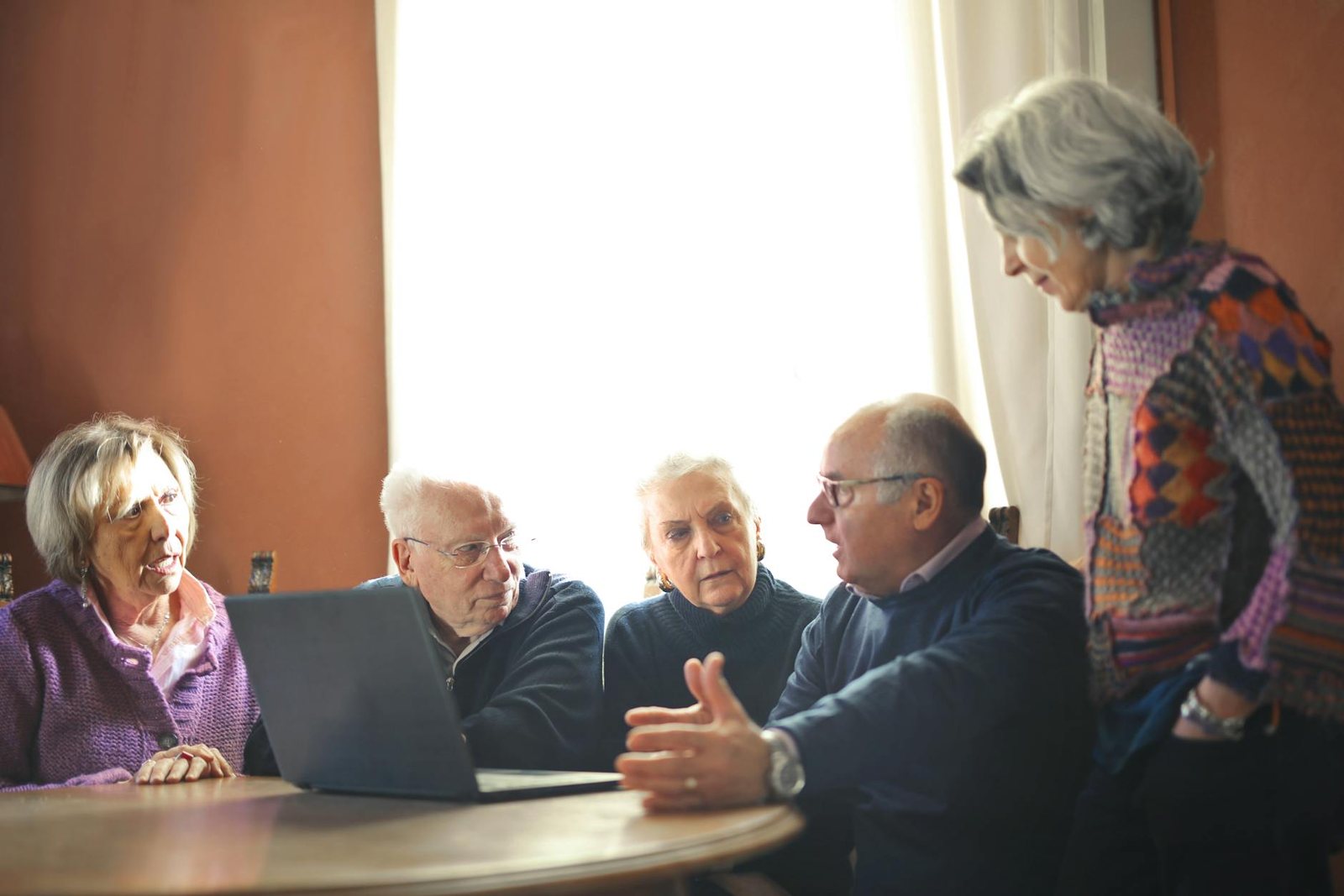
The intuition is the opposite. You’d think a room of fifty-something women going through similar divorces would feel safest and move fastest. It doesn’t. What moves people is hearing the same human truth come out of a mouth that doesn’t look like theirs. The thirty-year-old man says something about his loneliness that the sixty-year-old woman hears in a way she couldn’t hear from her best friend. The atheist hears the devout grandmother say something about forgiveness and realizes she’s been chewing on the same question for six months.
Different ages. Different genders. Different religious backgrounds, or none. Different stories of who left whom and why. Heterogeneous rooms heal faster because the climb is human, not demographic, and seeing the climb in someone unlike you is what loosens the grip of “nobody could possibly understand.”
What to look for in a facilitator
Before the red-flag/green-flag list, one filter that does more work than the others combined.
Look for a facilitator who names the hard part FIRST, before the program pitch. The first thing a good facilitator says shouldn’t be “welcome” or “glad you’re here.” It should name the courage it took to walk in. Something like: “Coming in here may have been one of the hardest things you’ve done lately. I want to affirm you for stepping out of your comfort zone.” Pain named before pivot. Courage affirmed before pitch. If the opener is breezy, motivational, or product-y, keep looking.
Look for a facilitator who can hold opposite needs in the same room. At a recent intro workshop, I asked the room what do you need tonight? One man said, “I don’t need people telling me what I should do.” The man two seats over said, “I love advice, though.” Both legitimate. Both held in the same minute. A facilitator who only knows how to talk to one type of attendee runs a room that works for half the people in it. The good ones can hold both, and underneath both is the deeper request a third attendee named directly: “I need permission to be authentic and vulnerable, and not have to put on a smiley face.” Permission, not prescription. That’s what you’re looking for.
Look for a facilitator who goes first. This is the one most group leaders never internalize. After I ask the room a question, I answer it myself, out loud, with a specific story from my own divorce, before I ask anyone else to share. The asymmetry of be vulnerable while I stay tidy shuts a room down faster than anything else. A good facilitator breaks that asymmetry openly, every time. Demeanor matters too: respectful, serious yet kind, tender, compassionate. If a facilitator is brittle, performative, or hidden behind a curriculum, the room can feel it. Trust your read.
Red flags vs. green flags when you’re shopping for a group
Here’s a short list to take with you. You’ll know within the first session or two.
Green flags, keep going:
- The facilitator names a curriculum or arc, and there’s a visible end date.
- The room has a mix of ages, genders, and backgrounds, not a single demographic.
- People who’ve come before keep coming back as alums. That’s the strongest signal a group is working.
- The facilitator makes space for pain without rushing past it, AND points the way forward when the time comes.
- Someone defines unfamiliar terms the first time they use them. No insider jargon.
- You leave the first session with one small concrete thing to try this week.
- Confidentiality is named explicitly, not assumed.
Red flags, trust your gut:
- The facilitator dominates. Members can’t get a word in.
- The framework is rigid, “this is THE way”, instead of “here’s one map, see if it fits your terrain.”
- Toxic positivity. “Everything happens for a reason.” “Look on the bright side.” If your pain is being skipped, the room won’t heal it.
- Cross-recruiting. The group is a feeder for someone’s coaching practice, MLM, or product.
- People use the room to relitigate their ex week after week with no movement.
- Pressure to share before you’re ready, OR pressure to perform recovery you haven’t yet earned.
- No clear end date and no visible alums, meaning, no one has actually graduated.
You’re allowed to leave a room that isn’t working. Twice, if you have to. The right room exists.
Three small commitments to take with you this week
Three doable things: pick one, or do all three:
-
Look up one structured cohort in your area or online. Not a drop-in. Not a faith-based program unless that’s specifically what you want. A cohort with a curriculum and an end date. Find a Group Near Me lists the ones we know of.
-
Read the names of the 19 Building Blocks. Just read them. You’ll feel which one you’re standing on right now. That recognition alone is worth the five minutes.
-
If a structured cohort sounds like the right shape, look at the Workshops Schedule. The next one starts soon. Just show up. Imperfectly enough is enough.
You don’t have to choose your whole future this week. You just have to take one step toward a room that has an arc.
FAQ
Q: What’s the difference between a divorce support group and divorce therapy? A support group is peer-based. You’re in a room with others walking the same path. Therapy is one-on-one (or family) clinical work with a licensed professional. They serve different purposes and many people benefit from both. A structured cohort like Rebuilding sits in between: it’s facilitated and curriculum-driven, but it’s a group, not individual therapy.
Q: Are there divorce support groups online? Yes, both drop-in and structured. The structured online cohorts can work nearly as well as in-person ones if the facilitator is skilled and the group commits to showing up consistently. The risk online is that anonymity makes it easier to lurk without engaging. The climb requires participation.
Q: I tried DivorceCare and it wasn’t a fit. Does that mean I’m not a person of faith? No. It just means that program wasn’t the right room for this season. Plenty of faithful people thrive in secular structured cohorts because they want their psychological work and their faith work in different rooms. That’s a healthy instinct, not a spiritual failure.
Q: What are the best divorce support groups for someone who’s been divorced for years and still feels stuck? Stuck is usually a signal that a block was skipped. A structured cohort built around the 19 building blocks is often surprisingly powerful for long-divorced people, because it lets you go back and do the climb you didn’t get to do the first time. Many alums tell us the work meant more the second time around than it would have at six weeks post-separation.
We’ve all weathered things we never thought we’d weather. The room you’re looking for exists. And it doesn’t have to be the room someone else handed you. Pick the shape that matches the climb you’re actually on.